Rome's Hidden Churches and the Caravaggio Route
TheVoyageCo asked Massimo to map a Rome itinerary built around art that has not moved in centuries. This is what he said.
Rome's best free art tour is a Caravaggio walk: San Luigi dei Francesi for the Contarelli Chapel (three Saint Matthew canvases), Santa Maria del Popolo for the Cerasi Chapel, and the Galleria Borghese (booked in advance) for early Caravaggio and the largest Bernini collection in the world. Pair it with Santa Maria sopra Minerva, the only Gothic basilica in Rome, and treat the Roman and Imperial Forums as a separate priority. Come in October.

Massimo
Hi, I'm Massimo, and for ten years I've been hosting tourists from around the world to discover Rome, its treasures, colors, and flavors. After studying Architecture and Art History, and after many years as an Art Director in Advertising, I decided to dedicate myself to tourism, driven by the desire
Massimo has one sentence to describe Rome: one life is not enough to discover it. His work is proving that point, one overlooked church at a time.
Massimo lives in Rome and advises travellers through The Voyage Co.
The church above Minerva that most visitors step around without going inside
In the centre of Rome, a short walk from the Pantheon, stands the Basilica di Santa Maria sopra Minerva. The name means Saint Mary built over Minerva: the church was constructed on the site of an ancient Roman temple to the goddess of wisdom, and the Gothic architecture is an anomaly in a city of Baroque and Renaissance. Rome has very few Gothic churches. This is the only major Gothic basilica in the entire city.
Santa Maria sopra Minerva, Massimo says, when asked what tourists miss. The church contains a Fra Angelico fresco cycle in the Cappella Carafa, Michelangelo's sculpture of the Risen Christ standing beside the altar, and the tombs of two popes. On the piazza outside, Bernini's famous elephant carrying an ancient Egyptian obelisk on its back stands as one of Rome's most curious monuments.
And yet visitors walk past it consistently. The Pantheon, a few minutes away, absorbs virtually all the attention. The Minerva sits quiet and extraordinary behind it, free to enter, never crowded, containing some of the most significant art in the city. The first time you go in, the Gothic ceiling alone is enough to stop you. The art inside is the reason to stay.
One life is not enough to discover Rome. The Minerva is the proof. It is two minutes from the Pantheon, free to enter, and contains a Michelangelo statue. Almost nobody goes in.
Where can you see Caravaggio paintings in Rome for free?
One of the stranger facts about Rome is that several of Caravaggio's most important works remain in the churches they were commissioned for, exactly where he intended them to be seen: in dim light, at the scale of a wall, in the specific context of a worshipping community.
The Church of San Luigi dei Francesi, a few minutes from the Pantheon, contains the Contarelli Chapel with three large Caravaggio canvases depicting the life of Saint Matthew. The lighting in the originals was calculated for the natural light entering from a specific direction at a specific time of day. You can still see this. The Church of Santa Maria del Popolo contains the Cerasi Chapel with two more Caravaggio paintings: the Conversion of Saint Paul and the Crucifixion of Saint Peter. Both are accessible as part of an ordinary church visit.
A Caravaggio paintings walk is Massimo's first recommendation for a 48-hour visit. This is not a museum tour. It is a walking route through active religious spaces, moving between buildings that have been standing for centuries, encountering works of art that were made for exactly the spaces they occupy. It requires no booking and costs nothing.
The Galleria Borghese adds a third dimension. The villa museum in the Villa Borghese park houses some of the most important early Caravaggio works, including the Boy with a Basket of Fruit, the Self-Portrait as Bacchus, and the Madonna dei Palafrenieri. The Borghese also holds the largest single collection of Bernini sculpture in the world. Entry requires advance booking and is controlled at a maximum of 360 visitors per two-hour slot, which makes it one of the calmer major museum experiences in Italy.
The Roman and Imperial Forums: what you actually need to understand them
Massimo's 48-hour framework includes the Roman Forum and the Imperial Forums as a separate and serious priority. These are not the same as the Colosseum. The Forums are the civic and religious heart of ancient Rome: the temples, basilicas, and public spaces where Roman political life happened over more than a thousand years.
They are also, without context, difficult to read. The ruins are extensive and the reconstructions are partial. Most visitors walk through them quickly without understanding what they are looking at. With context, the Forums become one of the most compelling sites in Europe. Without it, they can feel like a large field of old stones.
Massimo's recommendation to include the Forums in a 48-hour visit is a sign of how he thinks about Rome: not as a collection of sights to be photographed, but as a city with a continuous history that needs to be understood in sequence. Caravaggio in the churches, then the ancient civic world in the Forums, then the Borghese for the Renaissance and Baroque. Three different centuries, three different versions of the same city.
On the Colosseum, and what it means to visit Rome correctly
Colosseum is Massimo's answer to the overrated question, but his objection is specific. He is not saying it is not worth seeing. He is saying it is worth seeing in the right way, and most visitors don't.
The standard visit, joining the general queue, produces a partial experience: the exterior and the main arena floor, which was reconstructed and does not reflect the original appearance of the space. The underground tour gives access to the hypogeum, the subterranean network of corridors and cages from which animals and gladiators entered the arena. This is the part of the Colosseum that most visitors never see and that most directly explains how the spectacles worked.
The same principle applies to the mistake Massimo identifies most consistently: eating badly in touristic places. Rome has a well-established system of tourist restaurants around major sights that serve mediocre food at high prices, targeting visitors who don't know where else to go. Walking one or two streets away from any major monument, or asking someone who lives there, produces a completely different result.
When to come and what to eat
October is Massimo's preferred month, followed by April and May. October for the same reasons most Rome locals cite: crowds beginning to thin, weather still genuinely good, and the city returning to something like its normal pace. April and May for the spring light and the flowers on the Spanish Steps, but more practically because the crowds have not yet peaked to their summer intensity.
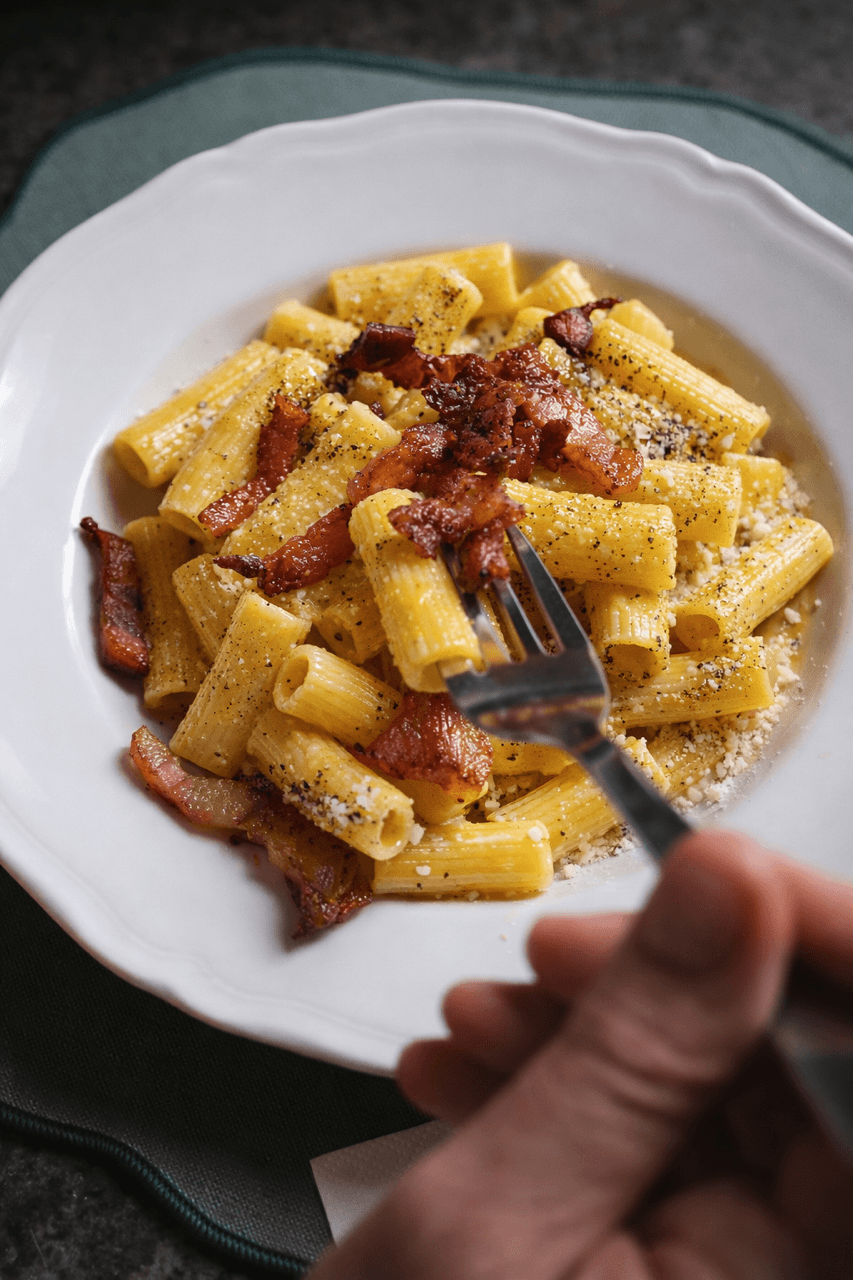
For food, he names the four Roman pasta dishes that define the city's cuisine: cacio e pepe, gricia, carbonara, and amatriciana. He calls them the fabulous four.
Each represents a different combination of the same base ingredients, principally guanciale (cured pork cheek), Pecorino Romano, and black pepper, used in different proportions and preparations. Cacio e pepe is the simplest: pasta, cheese, pepper. Gricia adds guanciale. Carbonara adds egg. Amatriciana adds tomato. A well-made version of any of them at a traditional Roman trattoria is a better argument for the city's food culture than anything available in the tourist zone around the Colosseum.
Massimo's Rome is not the one in the morning rush at the Colosseum gate. It is the slower one, the one that exists inside churches that have never moved their art, on a piazza that empties at lunch, and at a trattoria table where the pasta is one of the fabulous four. Walk the Caravaggio route. Book the Borghese. Give the Forums an afternoon. Come in October. The city is much larger than the queue you came to stand in.

Rome art and history FAQ
For more on Rome, see Massimo's Rome food day and Barbara's 48-hour itinerary.